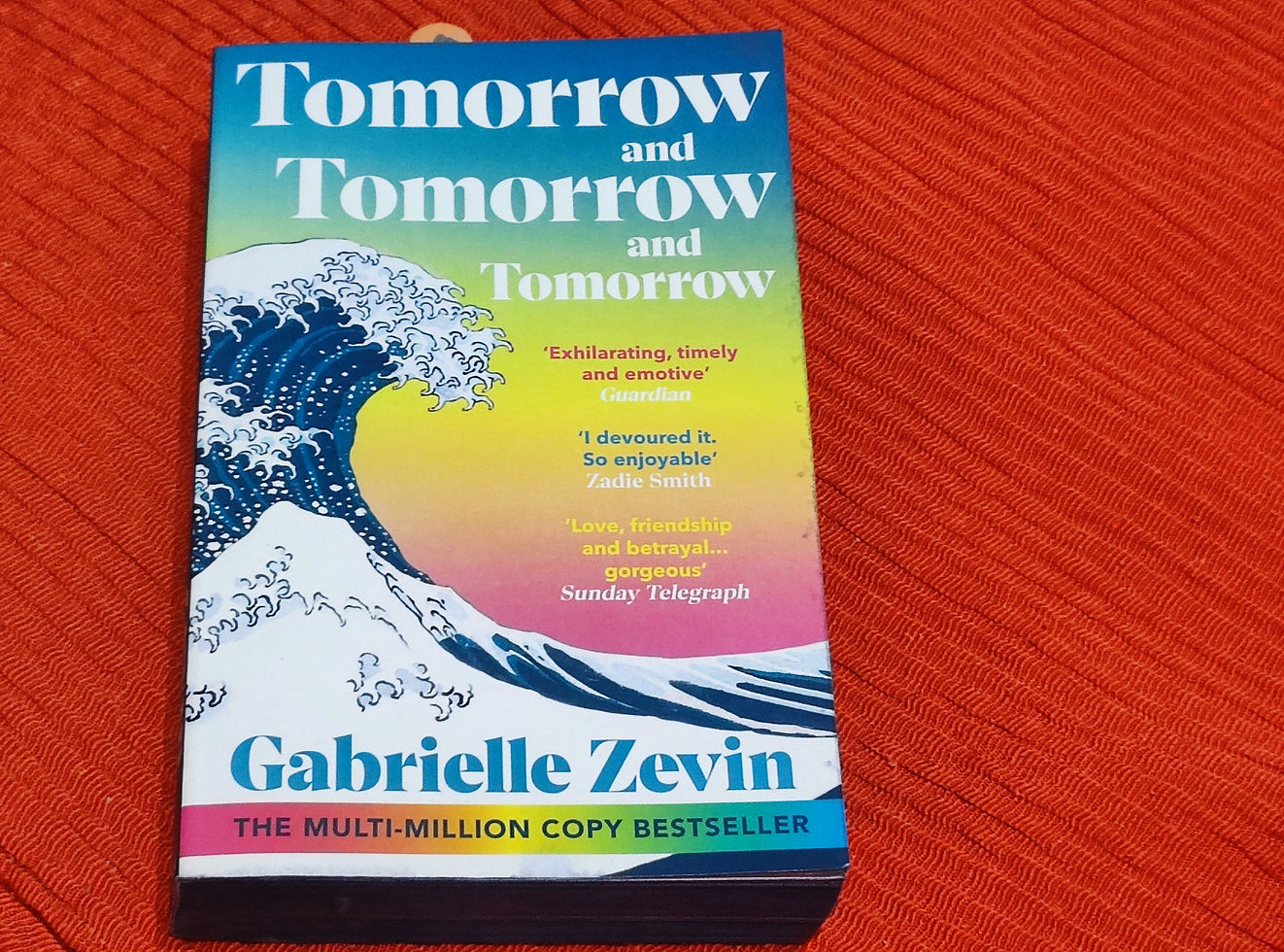
"Tomorrow and Tomorrow and Tomorrow" by Gabrielle Zevin, Review

Started: 7th August, 2024
Finished: 10th September, 2024
Now, you can't tell me there's no inherent order and rational structure in the universe.
One evening, my mother had an appointment in Valletta. My father and I came along too, and we decided to wander aimlessly around the city. I stopped at Agenda and looked for the book "Tomorrow and tomorrow and tomorrow". I'd been searching for it for a while, but I had no luck finding it.
Usually I don't buy new books, I order them second hand. But something in me compelled me to buy this book. I asked my dad if I could buy it with the money he gave me to spend on holiday, and he said yeah! So, just as I placed the book onto the cash desk to pay, my mother walked in and mentioned she had a loyalty card with agenda. The cashier typed in her details, and I found out there were €16.50 euros saved on that card! So instead of the original €16.99, I got my book for €0.79. Thank goodness I didn't buy it anywhere else.
As I was walking out, I saw a table with the same painting of the Japanese wave; 'The Great Wave off Kanagawa', as there is printed on the cover of the book.
I suppose the universe wanted it to be.
I believe this book perfectly encapsulates the essence of what I enjoy in a good read. There is little to no plot (or perhaps there is, but I didn't manage to find it?) and so the emphasis is entirely shifted onto our characters. They are beautifully fleshed out and real - I mean, look at this description of Sadie Green's hand. Something as (seemingly) simple as a HAND.
"Sam looked at her outstretched hand, which he knew as well as any hand except his own---the precise pattern of the lines that made up the grid of her palm, the slim fingers with the purplish veins at the knuckles, the particular creamy olive hue of her skin, her delicate wrist, pinkish, with a penumbral callus that must have come from Dov, the white gold bracelet she wore that he knew had been a gift from Freda on her twelfth birthday. How could she honestly think he wouldn’t know about the handcuffs? He had spent hours sitting next to her, playing games and then making them, staring at her hands as her fingers flew across a keyboard or jabbed at a controller. Tell me I don’t know you, Sam thought. Tell me I don’t know you when I could draw both sides of this hand, your hand, from memory"
(Yes I understand this passage is rather long, but I feel it proves my point well). A character I was also particularly drawn to is Zoe, who, although appears very briefly, intrigued me to a significant degree and embodied the type of woman I'd like to become.
"Zoe was sitting in the living room, cross-legged on an ikat-patterned cushion, and playing the pan flute, which she was currently learning. Her Titian hair fell past her breasts and she wore only underwear. Zoe always kept the heat turned up in her apartment so that she could wear as little clothing as possible. She liked feeling the vibrations of her instruments, she said. She liked feeling the vibrations of the earth underneath her and the air around her. There was a secret music, she claimed, that she could only hear when there was nothing between her and the universe."
In a relatively short paragraph, such a thick spiritual aura is built to surround Zoe, one which immediately instills a sense of peace and relaxation within me.
Also, this book is unusually - but delightfully - philosophical.
The parallelism between Sadie's game, Solutions, where players are tricked into behaving a morally due to a lack of skepticism - and Sadie's affair with her course teacher, who she winds up discovering is a married man, is frankly ingenius. This scene reminds me of the teachings of Socrates, his assertion that "an unexamined life is not worth living", and the importance of asking questions.
I like how the concept of time is a very central aspect to this book. For one, the timelines are constantly alternating between past, present, and future which can be disorientating at times, but interesting nonetheless. Sam notes how the central aim of video games is the "erasure of mortality", and walking through the glass-flowers museum (which, in of itself, is a testament to the human drive to preserve our work and legacies) is moved by the models of decomposing fruit. Decomposition ... another natural stage of the human life cycle. From Socratic Entelechies, this book also dapples with elements of existentialism - what is our existence worth, and will it ever amount to anything? - and touches on the great potential that resides within art to supersede human limitations and weaknesses. This sentiment is reinforced further, in the correlation between the books title, and the famous soliloquy from Shakespeare's Macbeth - where Macbeth mourns his empty and meaningless life, and contemplates what it is worth to live another day. Human lives are finite, whereas online worlds and video games offer the possibility of endless, infinite pathways and possibilities.
It seems as though existential ideologies are ubiquitous, in this book. I was particularly fascinated by the rationale behind Sadie's game proposal, "Both Sides " - There was the life you lived, which consisted of the choices you made. And then, there was the other life, the one that was the things you hadn't chosen - I like the way this ever so subtly addressed the conflict of determinism as opposed to free will. It seems to suggest that maybe, we weren't pre-determined to make the choices that we do, but an alternate life exists in which we freely chose an alternative path.
Also - this book intelligently mimicks the experience of playing a video game, by seamlessly threading through different perspectives and switching across timelines. One chapter that particularly stuck out to me was NPC - observing a character's final moments from the lense of a passive bystander, unable to act or intervene, was an experience quite unlike any other.
I found an uncanny correlation between a unit in philosophy being studied at school, "The Issue of Personhood", and a very small section of this book as Sadie is describing her young daughter Naomi.
"Sadie did not feel that Naomi was altogether a person. What person was a person without language? Tastes? Preferences? Experiences? And on the other side of childhood, what grown-up wanted to believe that they had emerged from their parents fully formed? Sadie knew that she herself had not become a person until recently ... Naomi was a pencil sketch of a person, who, at some point, would be a fully 3D character"
If I could describe this book in one word, it would be fascinating. It is quite unlike anything I've ever read before. I'm not sure if I got the point completely, but what I do know is that I thoroughly enjoyed the ride. I got to vicariously experience the life of young children bonding within the usually solemn environment of a hospital, college kids with an eager anticipation for whatever life has to offer, and successful game developers grappling with the loss of a beloved colleague and partner. I experienced alternate timelines and perspectives. And I loved each moment of it.


Comments